
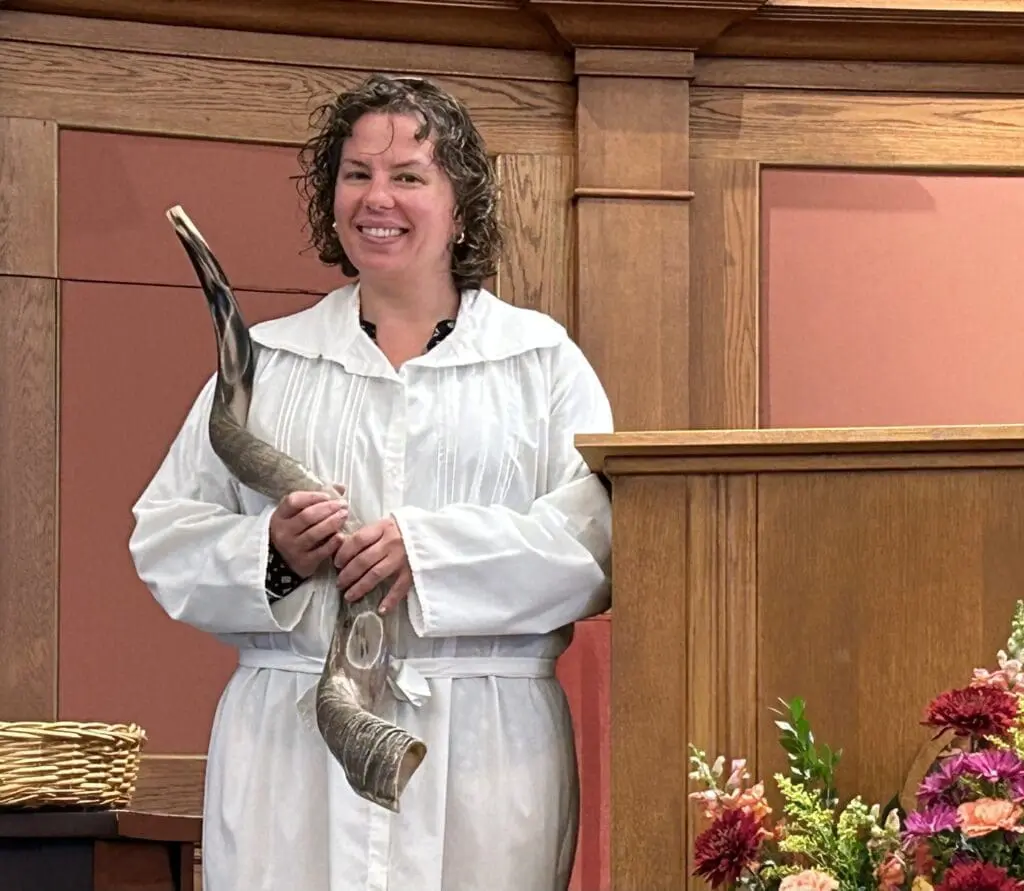
Rabbi Paskind’s Message, First Day Rosh HaShanah 5787 – Humanness In An AI World
Happy to share my message from the first day of Rosh HaShanah 5787 at Congregation Beth El – Norwalk:
Humanness In An AI World
Rosh HaShanah I 5787
Rabbi Ita Paskind
Congregation Beth El, Norwalk
The year was 1580. The place–the Jewish quarter of Prague. Rabbi Yehuda Loew led the Jewish community and served at the Alt-Neu Shul. Some of us have visited. In those days, the Jews of Prague lived in great fear of antisemitism in the form of pogroms. Not 200 years earlier had their ancestors suffered a terrible pogrom, and 3,000 members of the community had been killed. Rabbi Loew knew he had to do something–anything–to reassure his community that they were protected.
This is the supposed origin-story of the Golem, a human-like being created from clay, kavannah/intention, and secret incantations, and activated by placing a piece of paper with God’s name in its mouth. In theory, it would obey Rabbi Loew’s command and protect the Jews of Prague from would-be attackers. Famously, Rabbi Loew once forgot to deactivate the Golem before Shabbat. Instead of sitting patiently, or even coming to Shabbat services, the Golem seems to have gone on a violent rampage, throwing rocks, hurling trees, destroying property, and attacking people… until Rabbi Loew was able to pull the paper from its mouth, deactivating it.
What began as a deep desire to offer protection to a persecuted people ended in untamed violence, a very serious unintended consequence of creating something totally new, something completely autonomous.
It’s not a far leap from the Golem in 16th-century Prague to our own confusing/addicting/enticing experience of today’s autonomous tools, AI. It’s almost impossible to go through a day in our lives without encountering some form of artificial intelligence–from our phones to Alexa in our homes, from the little icon in our email offering to write for us. Flyers and images created by ChatGPT and Claude have become ubiquitous; and social media has filled with images and videos created by AI and, of course, made to look real. And this is just a sliver of the stuff we encounter daily. I don’t even know how to enumerate the ways AI has been integrated into every aspect of life! And that’s part of what makes it so confusing!
Sitting almost 500 years after the legend of the Golem, we have a pretty solid way to understand what it was, how it worked, and why it was created–and then deactivated. Today, living with an ever-accelerating pace of new technologies, and with artificial intelligence expanding its abilities exponentially, it’s a lot harder to process and analyze this contemporary autonomous tool.
The benefits are well-established, and we have experienced them personally. AI handles repetitive tasks with ease, processes massive amounts of data practically instantly, and observes patterns that humans might miss. These machines have been trained on the entirety of the internet, so they literally are repositories of human thinking. They are built to predict what we might want to say or do next, and they offer that to us in ways that can make us feel that they “understand” us. It’s incredible technology, available to us on any device and making our devices feel more and more critical to our everyday functioning. On a larger scale, we know that AI is also supporting and enhancing industries across the board, from reading medical images to identify disease, to catching fraudulent banking transactions, to tracking machine wear and tear in order to make repairs before something breaks. We have truly learned to use this technology to better our world–and we can’t even picture what comes next.
The benefits, as we know, also lead pretty directly to serious fears about these powerful machines, and I have a feeling that some of you could enumerate them better than I will. Our greatest fear is that these tools will become–or have become–so powerful that they will break out of their human-programmed tasks and cause harm. There is no way to remove the paper from the Golem’s mouth here. On a much smaller and more personal scale, we may fear that machines are listening to us at home and through our phones, that they are feeding us information and products based on their algorithms. We know that they can save us time, but are they also reducing our creativity, our personal productivity, and perhaps even our cognitive abilities? What is happening to the intellectual property so easily accessed by these tools? How many human jobs will AI replace? And what about the tremendous and growing environmental strain it takes to build these massive data centers, run them and keep them from overheating, not to mention mining the earth for the rare metals necessary to build the machines in the first place! I–and you–could go on and on about our concerns.
I’m not here to weigh in on whether AI is “good” or “bad”, or whether we should take advantage of it or try to avoid it. On this first day of a brand-new Jewish year, 5787, I want to suggest a different angle, perhaps one that might enable us to embrace the benefits of AI while doing our part to minimize the downsides. In this new and much-faster-paced world, what does the presence of AI illuminate about our essential humanity? What about being human now becomes more precious, more valuable, more important than ever to appreciate?
Today let’s explore four essentially human qualities that AI simply can’t touch, that we may have taken for granted for much of our lives, that can never be replaced.
The first is the uniquely human appreciation of effort–working hard at something. In Jewish parlance, this is the value of lo alecha hamlacha ligmor, velo atah ben chorin lehibatel mimenah, “you are not required to complete the task, but neither are you free to desist from it.” The presence of a tool that so, so easily eliminates our effort emphasizes something so crucial and so foundational in the activity of work.
The most obvious area where this plays out is learning, education.
Learning takes time, repetition, and effort. That old adage your parent told you a million times–apply yourself!!–well, that’s exactly what we’re talking about. That’s the part that disappears when we rely solely on AI tools. You type in a query in ChatGPT or Claude, and not 2 seconds later, you’ve got yourself an answer, a list of articles on a given topic, a brand-new image, a complete history lesson, or even a college essay! Sure, you’ve saved yourself a ton of time–and God knows that sometimes that’s exactly what we need–but there’s no effort to learn anything or produce anything. So essential to the human experience–not to mention our Jewish lives–is our investment in study. Who would we be if we subcontracted our years of classroom learning, our college and professional educations, our religious school or Jewish day school careers to a computer? We would lack the core knowledge inside our minds, and we would miss out on the confidence and pride in our knowledge that our effort produces. In this AI world, we must recognize explicitly how meaningful our learning experiences are–whether our past ones or learning that we are doing at this stage of our lives. We put in the effort to add new information to our knowledge base, to analyze, to create new understandings. This process changes the makeup and workings of our brains. While human beings will no doubt utilize AI for so many things we used to do on our own, our human appreciation of our effort to learn comes into sharp focus, and we must never give that up.
The second uniquely human quality is our ability to make meaning, to make things matter. This is fundamentally different from how fast we can draw a picture, or even from the finished product at all. It’s about why we choose to create, for whom we craft something new, why now?, and how it’s all connected. Our experience with the creative arts readily attests to this. Meaning is a huge part of what imbues art, music, theater, poetry, and literature with the wonder they inspire. A human mind conceived of that?!! Someone created that?!! Part of beholding a work of art is considering the process, the time invested, the motivation, the intended audience, and what it adds to its particular genre or art form. And then there’s the beauty of the art itself. It’s hard to put into words, but we know it when we feel it. We are touched. It means something.
Could an AI music tool create a piece identical to Beethoven’s 5th Symphony? Maybe. Probably. And I’m sure it would sound amazing. But I’m also pretty sure that it wouldn’t touch us the same way. What’s the difference? Not only did Beethoven not have the entire internet at his disposal, he was already aware of his deteriorating sense of hearing when he composed the 5th. His own life story flows through the melodies and harmonies, the rhythms and the movements, and that world-famous opening theme. This is true of every artist in every genre. Each is trying to make their mark in this world, and as the intended audience, our hearts are open to new meaning. That can never change.
The third uniquely human quality will be obvious to us all, sitting here in a synagogue–or participating from home–and that is our essential need for human connection. I know where your mind is going right now, because mine goes there too: But what about those stories of people who have fallen in love with their AI, whose AI proposed to them?! Without going too far into a different sermon, it’s important to acknowledge that this is a serious phenomenon. Last fall, the Times reported that 1 in 5 American adults “had an intimate encounter with a chatbot,” and the numbers are similar for American teenagers. We humans are engaging with AI tools when we need companionship, and that concerns me. Perhaps it concerns you too.
Because I think that all of us–members of this community–would agree that belonging to something greater than ourselves is a core part of human life. It feels even more important now that we have tools that will k’ilu–as if–ask us how we’re doing, respond to us, tell us we’re doing well or offer constructive feedback ever-so-gently, or even function as our therapist! Jewish tradition flows over with teachings celebrating the connection between humans, from Genesis recounting that God doesn’t want human beings to experience life alone, to the Sage Hillel admonishing us to “not separate ourselves from the community.” We human beings come wired for connection. Not only do we want to belong; we need relationships in order to thrive. That’s partners, extended family, friends, coworkers, classmates, synagogue community, workout buddies, or folks at the senior center… That’s a hug or snuggle, a Shabbat Shalom handshake, a sanctuary full of your people singing Avinu Malkeinu with you, a dance party, sharing a meal, holding a hand, growing old together.
Any of the people in relationship to us has the potential to look out for us, to notice if we’re not there, to care about our emotional well-being. We pay attention to one another. We are present for each other. We love and are loved. We need others, and are needed by others. AI can simulate a lot, but it can’t truly care about us. In this AI-infused world, we can and must appreciate each and every relationship we have. And we must nurture them. We must cultivate our uniquely human capacity to care.
And, finally, the fourth quality we possess that cannot ever be replaced is our capacity for the full range of human emotions, most notably in this season of compassion and forgiveness. In our tradition, this essential quality is something we model after God Godself. On these holiest of days, we sing before the open Aron Kodesh, Adonai Adonai El Rachum v’Chanun, God is merciful and compassionate, and our understanding is that we are also meant to behave this way toward one another. Sure, Claude can mimic the internet’s language of how to be compassionate, but it doesn’t feel anything. Sure, ChatGPT can feign offense at something we say, and if we choose to “apologize”, it can accept. But it doesn’t feel anything. This season of repentance, so foundational to our tradition, is based on our internal recognition that something went wrong in a relationship, and we have a desire to repair it. That’s an entire series of emotions! For teshuvah, repentance and repair, to be meaningful, both parties need to be emotionally invested in the relationship. Teshuvah is a uniquely human ability, and we are lucky that our tradition will never permit us to cast it aside. Nothing can replace it.
Effort. Meaning. Human connection. Compassion and forgiveness.
These are core to what it means to be human. They could never have been part of the makeup of Rabbi Loew’s Golem, and they cannot be incorporated into today’s artificial intelligence tools.
You know, after Rabbi Loew grabbed the paper out of the Golem’s mouth and deactivated it, it is said that he placed the Golem’s body in the attic of the Alt-Neu shul, where it has never been seen again. That technology was too strong, too uncontrollable for that community at that time.
Whatever our feelings about the existence or use of AI today, putting it back in the attic simply isn’t an option. It’s here to stay.
The pervasiveness of this technology necessarily shifts how we think of ourselves as human beings. For the vast majority of human history, thinkers of all backgrounds have sought to define humanness by differentiating us from animals, pointing to things like culture, language, and advanced logic. In our day, when so many of those human, non-animal qualities also define AI technology, we come back to that core question — what does it mean to be human — and perhaps find deeper answers.
On this day of Rosh HaShanah, the anniversary of the creation of the world, as we begin our world’s 5,787th trip around the sun, we have used our talents and skills to develop technologies our ancestors couldn’t even have dreamed of, and our era of AI tech has advanced that work exponentially. In this fast-paced world, it seems so easy to lose sight of who we are. But as we pause today to celebrate our humanity in the most universal terms, and to reflect on the magnificence of Creation, we can consider the ways that new technologies like AI cast light on who we will always be, which is, really, who we have been all along.