
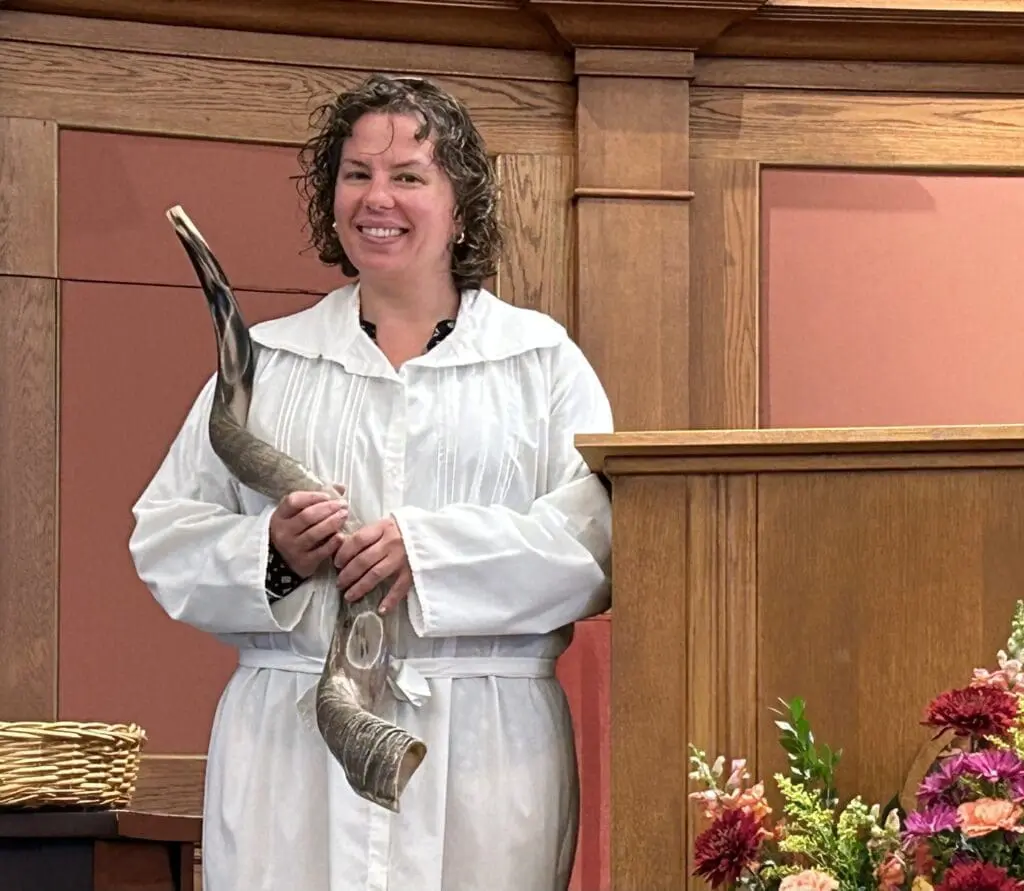
Rabbi Paskind’s Message, 2nd Day Rosh HaShanah 5787 – When All The Children Come Home
And here’s my message offered on the second day of Rosh HaShanah 5787 at Congregation Beth El – Norwalk:
When All The Children Come Home
Rosh HaShanah II 5787
Rabbi Ita Paskind
Congregation Beth El, Norwalk
Something changed for the Jewish people on January 26, 2026. You may not remember the date–I had to look it up, too–but many of you will remember how you felt the second I remind you what happened that day. On January 26, 2026, a team of 20 Israeli forensic dentists identified the teeth of Ran Gvili, the last remaining hostage who was murdered and taken hostage by Hamas on October 7, 2023. Just a reminder of the operation: his was the 251st body the army exhumed in a Gaza cemetery in order to recover Gvili’s remains and bring him home for burial.
With the body of Ran Gvili recovered and brought home to Israel, the long, drawn-out, torturous saga of the October 7th hostages came to a close. And something changed for the Jewish people. Our entire collective energy had been poured into bringing these hostages home–either for reunification with their loved ones, or for honorable burial in their homeland–and miraculously, incredibly, the goal had been accomplished. Personally, I remember the shock of realizing that there was no more “Prayer for the Hostages” on Shabbat, no more singing of “Acheinu”, no more high holiday or Shabbat sermons or kavannot focused on the hostages. The difference between those fervent prayers over the last 3 years and now is remarkable. Now, of course, there’s plenty to pray about with regards to Israel, but this particular dark chapter has come to a close.
From the start of the war, Israeli leadership articulated that bringing every last hostage home was one of its goals. Blessedly, it included in its rescue mission the body of fallen IDF soldier Hadar Goldin, and the living hostages Ethiopian-Israeli Avera Mengistu, and Bedouin Arab Israeli Hisham al-Sayed–all of whom were captured by Hamas over a decade ago, and were finally brought home. And even more recently–in May 2025 and just one month ago, in August 2026–the remains of the last 2 missing soldiers from the 1982 Lebanon War, Zvi Feldman and Yehuda Katz, were recovered in special Mossad operations. All of this is to underscore Israel’s explicit commitment to each of its soldiers and citizens–noone is to be left behind.
If I remember correctly, last year on the 2nd day of Rosh HaShanah, I introduced the haftarah from the book of Jeremiah by highlighting his prophetic hope after the destruction of Jerusalem and the exile of the Jewish people. Listen to his words:
V’yesh tikvah l’acharitech, ne’um Adonai, v’shavu vanim ligvulam.
“And there is hope for your future—declares Adonai: Your children shall return to their borders.” I gotta say, for most of my rabbi life, this haftarah got short shrift. It has some pretty lines that have been set to beautiful melodies, but there wasn’t much in the words that I thought would touch modern Jews. Until October 7, when all of a sudden, the mythical mother Rachel weeping for her children who are no longer, and this prayer that the children would one day return to their borders… wow, wow, wow, this was exactly the text we needed to feel seen in our pain, to feel like our tradition was throwing us a lifeline of hope. Just one year ago, our prayers for the recovery and return of the remaining Israeli hostages were front and center–more important to many of us than our own process of teshuvah, repentance.
And now, a year later? We hear those words so very differently: v’shavu vanim ligvulam, the children have indeed come home to their borders. It brings me to tears every time I think about this modern miracle, born of such ugliness and violence and hate, but made possible by incredible resilience, intelligence, and strength.
This idea of coming home to our borders, to our country, is so deeply meaningful and powerful for the Jewish people. Our nation’s story centers around our land, and the many times our ancestors claimed it, left it, returned to it, were exiled, returned to it, and were exiled again–for a long, long time–and a century ago returned once more. Some of you remember the 1947 United Nations vote to partition the land and create a Jewish State. Some of you remember the 1948 declaration of independence and the elation it elicited. Even more of you remember the pride at Israel’s victory in the 1967 Six-Day War. I could keep going with our specific memories, but the point I’m making is that almost all of us have felt personally how necessary, powerful, and central to the Jewish people having an official homeland is. It is essential.
My understanding of our homeland became both deeper and more complicated on my most recent visit to Israel last February. I shared twice on Shabbat after returning about this experience, but I’m glad to revisit it more widely today. I was one of 20 Conservative rabbis who participated in a four-day educational tour with an organization called Encounter, which equips Jewish leaders “to reckon firsthand with the Israeli-Palestinian reality, which has far-reaching consequences for Israel’s security, Jewish flourishing worldwide, and the lives of Palestinians under Israeli sovereignty.” During our whirlwind tour, we met with Jewish Israeli leaders and with Palestinian leaders from East Jerusalem and the West Bank. Our job–and it was a privilege, really–was to encounter each of them in their communities, and to plumb the depths of their understanding of the Israeli-Palestinian reality, to see what they thought the future could bring, and what it would take to get there. Not all of our guests were optimistic about the future; but all were willing to talk about the Israeli-Palestinian reality with a group of American rabbis.
For me, and I think for my colleagues, the voices we were most eager to hear were those of Palestinian speakers, simply because there aren’t that many opportunities to have these kinds of encounters. We met with peace activists, social scientists, a Palestinian Arab Greek Catholic priest, a young female politician, and the owner of the most well-known East Jerusalem bookstore. While each had their own story, their own perspective, the through-line was clear: They, their families, their communities want the same thing we have–an official homeland. It was impossible not to be touched by that yearning, a yearning we know so well.
I’d like to introduce you to one of our speakers, Khaled Abu Awwad. We met Khaled at Sarras Farm, an eco-tourism destination near Bethlehem in the West Bank, where he shared with us his personal narrative. Khaled’s family identify as Palestinian refugees. Originally farmers, they were displaced from their home in Kubebeh in the West Bank in 1948, and although they did return, they were displaced again in 1967, after which the family–parents and their 13 children –rented a home in Beit Ummar, not far from Hebron, also in the West Bank. They had no land to farm, and they bore a lot of hatred toward Israel for their situation. In the late 1980s, Khaled’s mother was deeply involved in Palestinian resistance to the IDF, and Khaled and his siblings were all imprisoned because of their participation. Things began to shift for the family with the signing of the Oslo Accords in 1993. Khaled’s family got on board with the possibilities the agreement opened up, and they were pretty vocal in their community that they were in favor of peace. Khaled’s personal turning point happened after his brother Yusuf was shot and killed in an IDF action in November 2000. A couple months afterward, they learned that a group of Jewish Israelis wanted to come and pay their respects–a shiva call. Khaled recounted that it was an awkward start, but that he appreciated that they had come to be present to his pain. After he told his story at the shiva call, one of the Jewish Israelis shared that he, too, had lost a loved one to this never-ending violence–his child had been killed by a terrorist in central Tel Aviv. And there it was: 2 men, sitting in their grief over unnecessary violence, realizing that something needed to change.
Today, Khaled is the Palestinian co-director of Roots, a non-profit organization that promotes dialogue and trust between Israelis and Palestinians. If he’s ever able to obtain another travel visa to the States, I hope to bring him and his dialogue partner, Rabbi Hanan Schlesinger, to visit our community. He is incredibly inspiring, not only because of his own experience, but because he has devoted his life to shifting the perspective of his fellow Palestinians in the West Bank. He wants peace. He wants an official homeland.
I can imagine that hearing me share this perspective may be hard, given all we’ve been through with October 7th and the ensuing war, given the rise of antisemitism here and everywhere–come back on Kol Nidre for that discussion–and yet I’m asking you to stick with me. I appreciate how challenging this conversation is.
One of the things that makes this topic really hard is the failure on the part of so many–especially in the media–to distinguish between the Palestinian people and Hamas. I’m sick and tired of Israel getting blamed singlehandedly for the war, with no mention of Hamas’ brutal October 7th massacre, and I know you are too. I want to be clear about the speakers I met on the Encounter trip: Not only did they articulate their desire for an official homeland; they also denounced Hamas’ attacks on October 7, said they were absolutely in the wrong, and that Hamas does not represent the Palestinian people. As an American Jew who strongly identifies with the Israeli experience, that was tremendously reassuring to me. I hope it does the same for you.
Friends, I keep thinking about our haftarah from today and how we all connect to the homeland of the Jewish people. What I was privileged to hear on my Encounter program and what so many others proclaim is the same connection to homeland, coming from people with a different national story but with so many similarities to ours. In slightly different words, I hear the dream of v’shavu banim ligvulam coming from those who share, or who once shared, the same land. I think it’s our turn–the Jewish people’s turn–to support the call for a Palestinian homeland, side by side with our own Jewish home.
I’m not talking about resolving all of the major issues facing our two peoples on this one land–and they are serious. Other people, way smarter than I, will hopefully figure that out one day, through careful negotiation and peace-building efforts. I also have no sense of a realistic timeline. My message today is that it makes a difference to say aloud that the Palestinian people deserve their official homeland, alongside the homeland of the Jewish people.
And friends, the timing couldn’t be more urgent. This year, and particularly this summer, has seen a stark rise in Israeli settler violence. These radical right-wing Israeli Jews believe that all of the land in the West Bank belongs to Israel, and they are determined to make that a reality. They pair violence against Palestinians in the West Bank with strategies to push Palestinians out of their homes, properties, and villages. Since October 7, 2023, settlers have carried out thousands of attacks against innocent Palestinians in the West Bank, injuring thousands. This year alone, more than 3,200 Palestinians have been displaced by these attacks.
Just last month, the Times of Israel documented a settler attempt to take over a Palestinian family’s home. Youssef Hassan, his wife, and their children–little girls ages 2 and 4–were trapped inside their home in the village of Qusra, as settlers surrounded the home, cut the electric lines, and built themselves a stronghold outside the front door. Every night, they screamed into the home, trying to intimidate the family, whose food supply was running low. It’s not hard to imagine how many Palestinians would flee their homes under such threats, and that’s exactly how the settlers take over their property.
To make matters much worse, there are rarely repercussions for this illegal violent behavior, due in large part to the approval of Israel’s Minister of National Security Itamar Ben-Gvir. This violence continues unchecked. What this means in the larger context is that the land that, under the legally binding 1993 Oslo Accords, has clearly been demarcated for Palestinians living under Palestinian control is being chipped away at increasing rates through violent illegal tactics. By Jews. This is unacceptable.
You may have seen the New York Times article from just 2 weeks ago, in which the reporters accompanied a group of retired brass from all of Israel’s military branches and former Israeli Prime Ministers Ehud Barak and Ehud Olmert on a tour of the West Bank. These men, who devoted their careers to defending the State of Israel and certainly directed plenty of military missions, expressed disbelief and shame at the unchecked violence and land grabbing. Earlier this summer, they issued a letter to Prime Minister Netanyahu threatening legal action if he did not take action to “immediately eradicate Jewish terrorism” in the West Bank. From their perspective, a Palestinian State–the other half of a 2-State Solution–is essential, if not for the dignity of the Palestinian people, then to protect them from settler violence.
Now, I’ve been your rabbi some time now. This is actually our 12th Rosh HaShanah together. I know some of you are nodding along with passion and are proud that your rabbi is giving this sermon. I also know that some of you are feeling ruffled by my message and that it may be hard for you to keep listening. I’m not sure, but there may also be some of you who find yourselves in a tentative middle on this issue, not really sure where you fall. Whatever you’re feeling belongs here. This isn’t the first time we will have expressed differing views about Israel, or even about Israel’s relationship to the Palestinians. We can do this, too.
I’ve been thinking about what it would take for a Jewish community–for our Jewish community–to support the existence of a Palestinian state, as a matter of principle, even if we can’t agree on or envision a particular political resolution. I think there are 3 ingredients–confidence, trust, and courage.
Confidence in the rootedness of our own homeland. Threats to Israel’s safety remain, but Israel isn’t going anywhere, and although there’s a small and finite amount of land, previous agreements have offered a blueprint for how to share it.
Trust in the Palestinian people to live beside Israel in peace. This is the security issue, which we know is major and active. But trust may be—perhaps must be—extended to the regular people who yearn for peace, for recognition of their state, for sovereignty. To people like Khaled and his family, and the many other Palestinians I met.
And finally, courage. I’m reminded of the charge that Moses offered to Joshua at the moment of their leadership transition. Chazak ve’ematz, “be strong and take courage.” Joshua was preparing to embark on a leadership journey that would take the people across the Jordan River into the Promised Land. It was all uncharted territory–I mean the land itself and the experiences they would have. I think the comparison is fitting for this moment.
Israel’s history also contains a remarkable record of leaders willing to offer territorial compromise for peace, beginning with Ben Gurion’s acceptance of the UN Partition Plan, and continuing with Begin at Camp David, Rabin and the Oslo Accords, and many more Zionist leaders. None of these processes produced the peace we hoped for. The reasons are complicated, and well-meaning people disagree about responsibility for their failure. But one lesson is clear: the idea of two peoples sharing this land is not opposed to Zionism. Many Israeli leaders and thinkers have supported it for decades.
Today, we know that current Israeli elected leadership are not pursuing this, but elections are coming, and the people will speak. We also know that not all Israelis–and not all Jews–want this outcome. And not all Palestinians are eager to live in peace beside their Jewish neighbors. My message today is to lift up the voices of those who do want a peaceful coexistence and who are working toward that goal.
Jewish organizations continue making the courageous move of supporting a Palestinian homeland. Tru’ah: The Rabbinic Call For Human Rights actively supports the creation of a Palestinian state. They mainly work with ordained Jewish clergy and with rabbinical and cantorial students. They facilitate tours for these leaders in West Bank and East Jerusalem villages. And they organize Jewish clergy to participate in protecting Palestinian farmers from settler violence during their crucial olive harvest each year. Another organization, the Center for Jewish Nonviolence, brings groups of Jews to live for a period of three months in Palestinian villages, to become part of the community and to experience first-hand the injustices of life in the West Bank, in hopes that they can use their Jewish privilege to make a difference.
The time for change is now, and both Palestinians and Jews are working to bring that dream to fruition. Just as it means the world to us to have neighbors and allies reaching out in support of the Jewish people when we are in this crisis of growing antisemitism–again, we’ll talk about that on Kol Nidrei–it makes immeasurable impact for the Jewish community to stand up and say that the Palestinians also deserve their homeland.
I pray that this year witnesses much less violence for all who call the land their home, and much more dignity for our Palestinian neighbors. And I hope we will be alive for the Rosh HaShanah when we chant this haftarah and will reflect with joy that v’shavu banim ligvulam–that all of the children–both Israeli and Palestinian–have come home to their land, the truest and most complete fulfillment of this prophecy. Ken yehi ratzon