
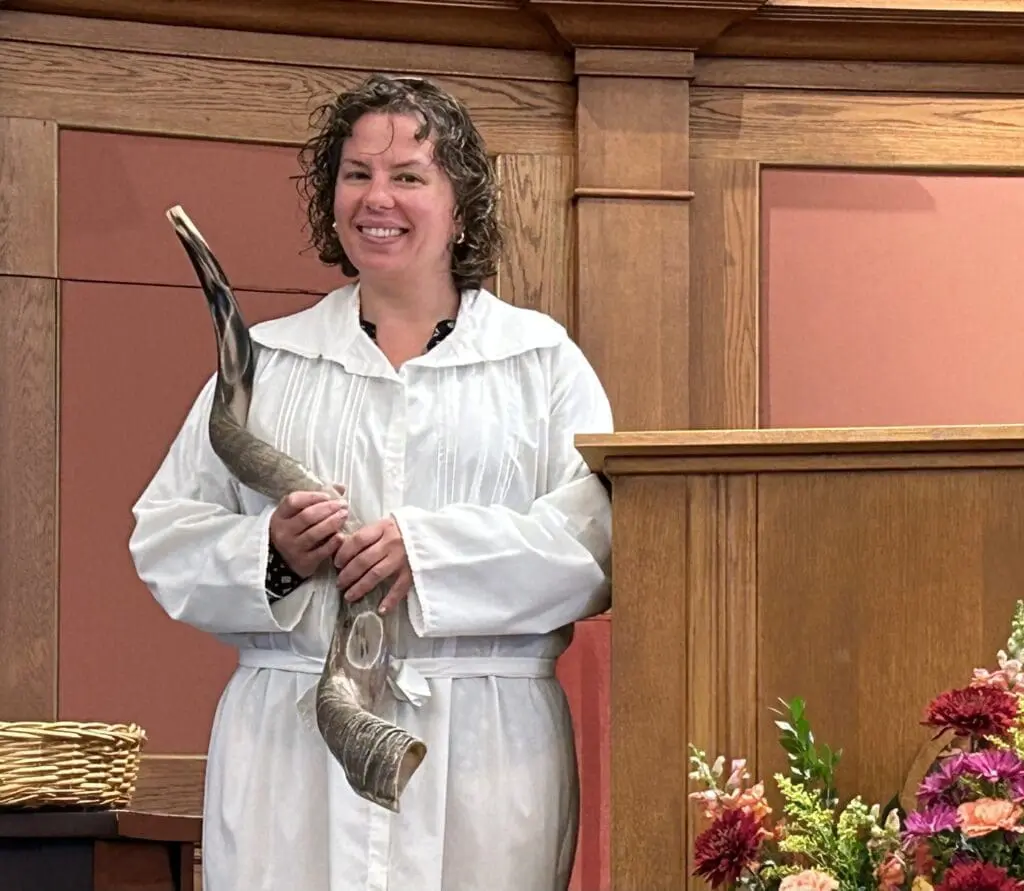
Rabbi Paskind’s Kol Nidre Sermon 5787 – Antisemitism Today
Antisemitism Today
Kol Nidre 5787
Rabbi Ita Paskind
Congregation Beth El, Norwalk
I have a friend–Sarah–who grew up in the States and now lives in Israel. She’s married to a guy who also grew up here and made aliyah, and together they have 3 daughters, in the elementary/middle school range. A few weeks ago, Sarah posted on social media about this thing her daughters do before each international trip the family takes. They do this without prompting from their parents. It’s a thing that deeply saddens their parents, but that the parents understand–and you will too. What is it? They brainstorm together which names they will use when they meet new people–names that are not Hebrew, names that are not immediately recognizable as Israeli or as Jewish. I bet you’re feeling the same gut punch I felt when I read Sarah’s post.
I myself had a related moment–also over the summer–when the kids and I were on a road trip. We were in Niagara Falls–the Canada side, which so many of you told me was the better side!!–and it was getting late one day, so I ordered us a Lyft. I was so glad that the car would arrive quickly. Our driver was Muhammad. As the 3 of us piled into Muhammad’s backseat, I hesitated. Should I tell the girls to buckle up in Hebrew, as I usually do? Or would that cause friction with Muhammad, and maybe I should just stick to English? I hated even having that thought, because I usually feel excited to meet a Muslim person. We’re uber-cousins, after all.
Uch. I know I don’t really have to articulate these feelings to you, because you get it. You’ve likely had your own version of these stories, and I’m sorry you’ve had to deal with this. To wear the Jewish star necklace visibly, or tuck it in? That is a question. To wear a kippah while out, or choose a baseball cap instead? To share something about Judaism or Israel on social media? I just don’t know. For a long time, that was a question reserved for Jewish folks traveling in Europe; now it’s something to consider here at home. This is the social climate for Jews these days. It’s hard to tell who is a friend and who might not be; it’s hard to know if folks we’ve known for a long time have shifted their views about Jewish people, especially in the last 3 years. And while these social dynamics are real and highly unpleasant, I think that our greatest fears are much larger than whether someone is still our friend.
Many of us were directly affected by the attack at Central Synagogue a month ago during the Friday evening service, and all of us paid attention. We are highly sensitized to antisemitic acts large and small, from the heinous attack last Chanukah at Bondi Beach, to the deadly shooting at the Tree of Life synagogue 8 years ago in Pittsburgh, to the attack at the Reform temple preschool in Michigan, to the Jewish man who was stabbed on the Upper West Side of Manhattan with a screwdriver on Tisha b’Av, and too many more to name this evening. Unthinkably, we live at a time when it’s again become socially permissible to target, attack, and murder Jews.
This major increase in antisemitic attacks strikes fear in each of us and raises questions–so many questions–about the safety and well-being of the Jewish people in this country and throughout our world. Tonight, as we begin this most sacred day together, I want to name them and address them together with you. I’ll tell you mine, with the understanding that you likely share some or all of them, too.
In no particular order:
I’m afraid that someone I know will be attacked next, or worse, someone I love. Or will it be me?
I’m afraid that, despite our excellent security plan, there will come a time when so many of us are too scared of coming into the synagogue building that I will end up leading high holiday services staring directly at the livestream camera.
I’m afraid that our children are growing up in a Jewish world where they’re learning more about synagogue security than they are about, say, Purim. And I worry about the long-term effects on their Jewish identity.
I’m afraid that, at a time when financial resources are hard-won, we are spending thousands of our hard-raised dollars on off-duty police protection rather than on amazing programming, and what that means for the health of Jewish communities in the long run.
I’m afraid of what’s happening in New York City, such an iconic place of Jewish culture and community, and now a place where Jews fear antisemitic attacks.
I’m afraid and saddened that, no matter what our current relationship is to the state of Israel, events in Israel have become more politicized and divisive than ever, have divided the Jewish community, and some of us feel that it’s dangerous to be explicit about our connection to Israel here in this country.
I’m afraid that we are so sensitive to the rise in antisemitism that we run the risk of thinking we’re seeing antisemitism even where it actually isn’t.
And while all of these fears are real and serious, what I think so many of us truly and existentially fear is that we are living through an historical repeat of 1930s Germany.
This is so, so heavy. That last one–the “does this end with another Holocaust” fear–that’s what makes the rest of our fears all the more terrifying.
I’m glad we’re talking about it tonight. In many ways, this is the “realest” day of our entire year, right? We come stripped of our bodily needs, laden down only with our emotional baggage and primed to open our souls vulnerably. Tomorrow, our Yizkor prayers are paired with the Yom Kippur martyrology, Eleh Ezkerah, “these I will remember”–individuals and groups who were murdered because of their devotion to Am Yisrael, the Jewish people. Rabbi Akiva–tortured to death by the Romans for refusing to stop teaching Torah. Rabbi Chanina ben Teradyon, a contemporary of Rabbi Akiva’s–burned to death while wrapped in a Torah scroll. The Jewish communities of Worms, Speyer, and Mainz decimated by the Crusaders in the 11th century, on their violent journey to bring Christianity to the Holy Land. 6 million Jews in Nazi Europe–murdered in countless ways for the sin of being Jewish. 1200 people in the Gaza Envelope area of southern Israel–murdered, raped, burned by Hamas terrorists on the 7th of October, 2023 for being Israeli, for being in Israel, for being Jewish or associated with the Jewish people and the Jewish State. Eleh Ezkerah–”these I will remember”–we draw a conscious narrative on this day between our people’s devotion to Am Yisrael and the too-many-times suffering, persecution, and murder. It’s a ritualized lesson in antisemitism through the ages.
It’s no wonder at all that our Jewish gut worries: Are we next?
Tonight I want to say clearly that I do NOT think that we are headed toward another Shoah. I don’t. That may be our overarching fear, but our circumstances–and our reality–are quite different.
The greatest difference, most obvious to us all, is that the elected leadership of our country–both our current administration and past administrations–have never targeted Jews with policies that single us out as less-than, other, undeserving of equal rights or education, or, God forbid, destined for harsh labor or death. The opposite is true: American Presidents, irrespective of political party, have always had a warm and deep rapport with the American Jewish community, starting with George Washington’s Letter To the Hebrew Congregation in Newport, Rhode Island and continuing to today. We may not love every single decision our elected leaders make–even as egregious as giving the green light to neo-Nazi marchers in Charlottesville, Virginia, even as egregious as putting Jewish New Yorkers at risk via anti-Israel statements–but I don’t think we could ever compare our government to the Third Reich in its treatment of Jews.
Another marked difference–one that we know quite well here in Norwalk and surrounding towns–is with regard to the relationship between the Jewish community and the police force. In all my years of rabbi’ing, I’ve never seen such camaraderie, collaboration, consultation, and care as I have seen coming from the Norwalk Police Department. Here I want to pay special tribute once more to our 2026 Gala Honoree Deputy Chief Terry Blake, who has served as the liaison to Norwalk communities of faith the entire time I’ve worked here. He texts to check in right after an antisemitic attack, to reassure us that NPD will step up their patrols around our building. He consults on evacuation plans and security setup for these holy days. He works with Danielle to make sure that we have the coverage we need to feel and to be secure. I hope every synagogue in this country has an officer like Deputy Chief Blake.
In addition to our city’s police department, Jewish communities across the country have an added layer of support and protection. SCN, the Secure Community Network, is the official safety and security organization of the Jewish community in North America. The organization is staffed by intelligence, national security, law enforcement, homeland security, and military professionals, including our own representatives, Mike Butsch and John Andrews. Many of us have taken the opportunity to be trained by these pros, who are employed directly by our Jewish Federation of Greater Fairfield County. We have learned to identify folks who don’t belong in a synagogue, deescalate a threatening situation, respond to an active shooter, and even how to protect ourselves from threats online.
I’m not getting any sort of kickback from SCN tonight, but I’m sharing all of this with you so that you know how deeply invested local and national law enforcement are in the safety and protection of the American Jewish community. We are not impenetrable, as we well know, but we are not alone. No Jewish communities in the past ever had these kinds of supportive relationships with law enforcement.
I’ll bring us back to Central Synagogue to demonstrate one other marked difference in the status of the American Jewish community. You remember what happened at Central the Friday night after that awful attack? Shabbat services were attended by NYPD Commissioner Jessica Tisch, Archbishop-Emeritus Cardinal Timothy Dolan, and Reverend Adriene Thorne of The Riverside Church–a beautiful demonstration of friendship and solidarity. And the sanctuary was packed. I really want us to hold on to that reality, much more than the attack itself. The coming-together is crucial to what it means to be Jewish–and American–in the United States in the 21st century.
OK. I admit, not reliving 1930s Germany is kind of a low bar. I also admit that all of the protective layers and relationships we have nurtured in this country can’t solve all the problems we’ve been discussing tonight. Some of them we cannot solve. But pausing for a reality check does give us some breathing room around them. It enables us to face the reality of where we are, not where we fear we are again.
And where we are is… here. It’s Yom Kippur, and despite the levels of antisemitism, despite our fears, we chose to come here, to shul, to be together. That’s how important this is to us. Look around this sacred space–see your friends and fellow community members. It’s OK to wave hi. Coming here is that important to each of them. If you can, turn around, look up, and wave hello to our community members joining us from home–it is so good to feel your presence on this holy day.
We spend so much time bemoaning what others think of us, what they’re saying about us, what they’re doing to us–as we must. But there’s something much deeper at play here, and that is why our Jewish identity, our tradition, our culture, our language, our Jewish peoplehood is so very important to us. After all, if it didn’t matter and we thought the world was out to get us, we could just walk away. And none of us have done that.
Our Judaism is so deeply rooted inside us that we wouldn’t even be ourselves without it. For some, it’s about the rhythm of the week, culminating in Shabbat, a day of rest and connection. For some, it’s about music, or Chanukah, or Passover, or Hebrew, or Yiddish, or bagels, or Borscht Belt humor. For some, it’s about the closest of friends we made at Jewish camp or through Hillel on campus or on a trip to Israel. For some, it’s about our connection to the State of Israel and its people. For some, it’s about our people’s inherited narrative of a redeemed enslaved people who brought–and bring–light to the nations of the world. For some, it’s an identity forged over thousands of years of overcoming persecution in every generation. For some, Jewish tradition is about these holiest days of the year, with their outward pomp and circumstance paired with their insistence on internal and relational work. For many, I suspect, it’s about the legacy our parents, grandparents, and long-gone ancestors gifted to us–we are who we are because they molded us that way; we are here because we used to share this day with them. And for some of us, we’re not sure what our Jewish identity is, and that’s beautiful too; it’s a commitment to a question, to a journey, to an exploration.
I do not think that we are in the kind of danger we have been in the past. That does not mean that our fear is unjustified, or that antisemitism is not a real threat to our communities. But I hope that as we make our way through this fresh new year, we might be able to see antisemitism for what it is and not what we fear it might be. I hope that we find strength in the friendships and relationships that support us when things are rough for our people. It is in those relationships that we will be nurtured and protected, and able to find resilience, in our times of risk and anxiety. And most fervently, I hope that each of us will hold fast to, or even deepen, the parts of our Jewish identity that make this entire enterprise worth it. We all have reasons for being here tonight, for making Judaism a part of our lives, even when it feels scary. Let us recommit to those reasons, and let us remember that we are not alone as we do so. Even though our reasons may be different, we are stronger together.