
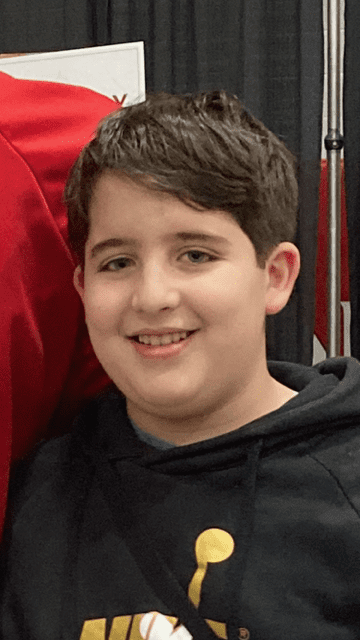
Parshat Emor D’var Torah – Benjamin Rotstein Bar Mitzvah
Shabbat Shalom everyone,
Parshat Emor is a bit of a “greatest hits” parsha. It includes laws for the Kohanim, the rules for the Temple service, and a review of the Jewish holidays. It’s kind of like the Torah’s version of a Jewish mother: full of rules, but only because it loves you.
Let’s start with the Kohanim—the priests. Emor lays out special restrictions for them. They can’t come into contact with the dead, can’t marry just anyone, and have to maintain higher standards of purity.
Now, some of you might think that sounds unfair. Why do they have so many rules? But I get it. When you’re working in the Temple, dealing with sacred offerings, and representing the people before God, you’ve got to be on your A-game. You don’t want someone showing up late, in a wrinkled robe, with a latte in one hand and a goat in the other saying, “Sorry, I hit traffic on the way from Judah.”
The Torah continues to speak about rules for the kohanim, and it goes into great detail about physical traits. Specifically, if they have any kind of difference, they aren’t allowed to serve in the mishkan, or tabernacle. In the biblical book of Leviticus, chapter 21, verses 18 – 20 the torah says:
“No one at all who has a defect shall be qualified: no man who is blind, or lame, or has a limb too short or too long;
no man who has a broken leg or a broken arm;
or who is a hunchback, or a dwarf, or who has a growth in his eye, or who has a boil-scar, or scurvy, or crushed testes.”
It seems like if any major part of a priest’s body has a physical difference–whether temporary, like a broken bone, or permanent–they are disqualified from offering sacrifices on behalf of the people. These restrictions seem to exclude people based on something they can’t control, which clashes with our modern value of equality of all human beings.
While reading this parsha I have been trying to put myself in their shoes and how the excluded kohanim must have felt. They may have felt disappointed or sad at not being able to serve, or maybe even embarrassed or excluded from the rest of the priests.
But their physical differences didn’t strip them fully of their status as priests. They maintained certain privileges, like eating the special foods reserved for the priests, and in that way they might not have felt 100% excluded.
One of the greatest values in Jewish tradition is the idea that ALL human beings are created in God’s image, b’tzelem Elohim, and that we are each unique and special. The fact that Parashat Emor makes distinctions between able-bodied priests and disabled priests is troubling to the modern Jewish person, especially because we place such a high value on equality. Studying this parasha has raised for me the issue of equal access for people of all abilities. Here are some examples that I’ve seen first-hand, starting with school.
At school, there are so many obstacles that could limit the learning of a student with a disability, like stairs, loud noises and smells, lots of people, and limited time to write a paper or take a test. In order to give all students equal access to learning, schools have different ways to help neurodivergent students or disabled students. There are ramps and elevators, and on all pieces of signage in school, there is Braille text, just like in all public buildings. Sometimes students can get extra time on tests and assignments, and they also get a support staff person to go with them class to class, to help in any way necessary.
Inclusion is not limited to schools and other public buildings. It can also occur in sports. Many of us are familiar with national and international sports competitions that are particularly meant for people with disabilities. But there are also different models of inclusive sports out there for regular kids, ranging from pairing disabled and typical kids on the same team, to modifying the rules or the equipment in the game so everyone has what they need.
Thinking about inclusion in schools, other public buildings, and in sports–among other areas of life–connects to the Torah’s discussion of the kohanim. Whether in a classroom or on a sports team, at work or at camp, we recognize that people of different abilities are part of our community, and it is our responsibility as community members to ensure that no one is excluded based on something they can’t control.
I am glad to live at a time when our society recognizes the value in all human beings and pays careful attention to how we can include everyone of all abilities.
This D’var Torah focused on the kohanim, but as I mentioned at the beginning, Parashat Emor also provides a long list of the Jewish holidays, which are very important in my life. And what I really want to share with you is a main theme of so many of our Jewish holidays: “They tried to kill us, we survived, let’s eat.”
But beyond the humor, our holidays also teach us to appreciate what we have—and to help those who don’t.
For my Mitzvah Project I am collecting non-perishable kosher food products to donate to Schoke Jewish Family Service. This project is important because this food drive will help combat families going hungry. I’ve been collecting food for the last few weeks here at the synagogue, and if you’d like to contribute, you can bring in Kosher non-perishables after shabbat. I would like to thank Aubri Doughty from JFS. She was a big help for setting up my project and made it much easier than it could have been.
Thank Yous
To my parents: thank you for all the love, support, and reminders to practice my Torah portion. I know listening to me chant the same few lines over and over again was probably like living in your own personal Groundhog Day, but in biblical Hebrew. ¯\_(ツ)_/¯
To My sisters: Risa and Miranda Thank you very much for being great role models … of what not to do.
To Morah Rhonda: Thank you for answering all my questions… and for pretending they weren’t the same questions every week.
To Bracha Moshe: Thank you for all the help preparing me for today. Any parts that sounded really good were because of you.
To Moreh Leo: Thank you to my Hebrew school director for helping guide me to this moment—and for making Hebrew school a place I’ll miss.
To Rabbi Paskind: Thank you for all that time you spent helping me in preparation for today.
Thank you to everyone who came here to celebrate with me today. Especially to those of you who came from long distances.
And finally, thank you to the Beth El community, for supporting me and cheering me on as I grew up here and prepared for my Bar Mitzvah.
Please turn to page 734 in your red Etz Hayim chumash and follow along as I chant the haftarah.
Shabbat Shalom!
Click here to watch Benjamin Rotstein’s D’var Torah – Parshat Emor
Click here to read Benjamin Rotstein’s D’var Torah – Parshat Emor