
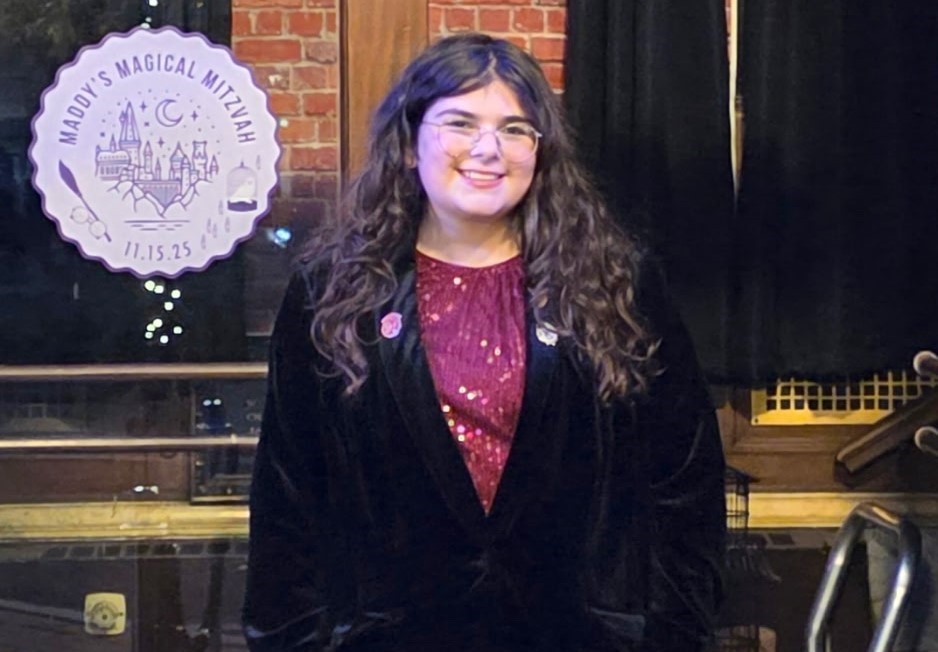
Maddy Kessler Bat Mitzvah D’var Torah
Shabbat Shalom.
In Parashat Chayei Sarah, today’s Torah portion, Sarah, the first matriarch, dies at the age of 127. Old. Very, very old. Abraham takes it upon himself to purchase a burial plot for Sarah, and he chooses the cave of Machpelah, which is owned by Efron the Hittite. Efron wants to offer Abraham the cave as a gift, but Abraham insists on purchasing it for 400 silver shekels. In today’s currency, that would be about 5,000 US dollars. He is then able to bury his beloved wife.
The remainder of the parasha focuses on the next chapter of this family’s story–finding a suitable wife for Abraham and Sarah’s son, Isaac. Abraham sends his servant, Eliezer, to Abraham’s birthplace to find a wife, and Eliezer takes this job very seriously. In order to figure out which woman it will be, he devises a spiritual test: the woman who offers him–Eliezer–water and water for all of his camels will be the right woman. And lo and behold, Rebecca approaches Eliezer at the well, and immediately she offers water to both him and to his ten camels. Did you know that a single camel needs at least 25 gallons of water after a long journey?! And if Eliezer had 10 camels, then Rebecca was offering to draw over 250 gallons of water from the well! What an arm workout!
Eliezer invites Rebecca to return with him to Abraham and Isaac, and she agrees to marry Isaac. At the end of the parasha, Abraham dies at the age of 175, and his 2 sons Isaac and Ishmael come together, despite a long estrangement, to bury him in the same place he had purchased for Sarah, the cave of Machpelah.
I really connected to the part of this parasha that focused on Eliezer and his journey. The camels caught my attention, but there’s something much deeper going on. Why would Eliezer focus so specifically on seeking out a person who would draw water for his camels? It’s because someone with this focus is most likely kind, compassionate, and caring. And if they care about animals, then they probably care about human beings too. Rebecca cared about Eliezer and his camels, and he inferred that she would behave that way toward Isaac.
Now, Eliezer knew how important these qualities were in Abraham and Isaac’s family. You might know that Abraham, when he was a few years younger, had become a model of hospitality—he and Sarah even prepared a delicious meal for 3 desert visitors shortly after his own circumcision! Now that’s a big deal! Eliezer knew that Abraham would want a wife for his son who would care about others in the same way.
And there’s more. Eliezer also knew that Isaac had just been through 2 big traumatic experiences— the Akedah, or binding of Isaac, when Abraham almost sacrificed his son to G-d; and the death of Isaac’s mother. So he really needed someone who would take good care of him and help him heal from these very difficult experiences.
Now, we’ve talked quite a bit about Rebecca, but this Parasha is named for Sarah and her death, and I want to teach a bit about that part of the story. It’s odd that the Torah never tells us how Sarah died—just that she died and her age when that happened. Rabbis have debated for AGES about how Sarah, the first matriarch, died. And all of their suggestions come from the fact that Sarah’s death is recorded right after the conclusion of the Akedah, the binding of Isaac.
To make a long story short, Abraham had the knife raised above Isaac’s head when an angel called from up above, “Hey, man! Don’t do it! Instead, sacrifice that ram in the bushes over there that just so happens to be at the right- or wrong, depending on your point of view- place at the right time.” So Abraham, being a good person and didn’t want to sacrifice his son in the first place, untied Isaac and killed Mr. Rammy. Some rabbis say that Sarah died of shock when she heard that her son was almost killed by his own father. That is a reasonable reason, I suppose, but I still think that an emu ran her over with a skateboard.
In my life, I have so many friends and family members who are really kind and compassionate. When Rabbi Paskind and I were discussing the compassion of Rebecca, I brought up my friend Alice. Alice is one of the most kind people I know. Similar to Rebecca, she’s not only kind to people, but she really loves animals. She has pet cats, and she also fosters cats sometimes. In the last litter she and her family fostered, they ended up adopting 2 of the cats. I think that really shows how much she cared for them, by not only offering a temporary safe space for them, but by adopting them and giving them a forever home. Also, they’re really, really cute kitties. Going back to the parasha that we’re talking about. I said earlier that Rebecca drew over 250 gallons of water from the well, but what if someone wasn’t able to do that? They might be the most caring and compassionate person in the world, but for whatever reason that may be, they aren’t able to draw water from a well. If this is the case, Eliezer’s test is not the best way of telling who would be the best wife for Isaac. But it’s okay. Maybe Eliezer wanted someone really strong, or someone who was free to roam around wherever she wanted. Whatever the case may be, in the end, Isaac and Rebecca got married, and she got into the Amidah—one of Judaism’s core prayers—soooo win-win.
For my Mitzvah Project, I’m going to be working with Moreh Leo to write and direct the Kesher Purim Play! I really wanted to find a Mitzvah Project that would be something that I love to do. At first, it was a little hard to find something that spoke to me. I knew a bunch of my friends were making bracelets, but that wasn’t really my thing. I wanted to help my community, right here in Norwalk (or Stamford. It depends on the week), Connecticut. When Moreh Leo asked if I wanted to help them with the Purim Play, I knew that it would be so fun. Not only would I get to show the future generation something that I love, I would get to connect it to my Jewish culture, and that’s what really matters to me.
I am really, really grateful to everyone who helped me up to my big day. Bracha Moshe, for being so kind and patient and supportive all the way up to this service, Rabbi Paskind, who made learning prayers and writing speeches fun, Dad, well, you helped a little, but you were mostly there for moral support, but I’m still thankful, Mom, for always being there and also waking me up early enough to get here, Amelia, my best buddy. You are amazing. And finally, I want to thank all of my friends and family who normally don’t go to synagogue, especially the ones who had a pretty long car ride.
Now, if you don’t mind, please turn to page 194(I think) in your Humash (the red book for you non-synagogue goers) and if you want, you can follow along while I chant my haftarah. Buckle up, because this is a long one.
Shabbat Shalom, everybody!